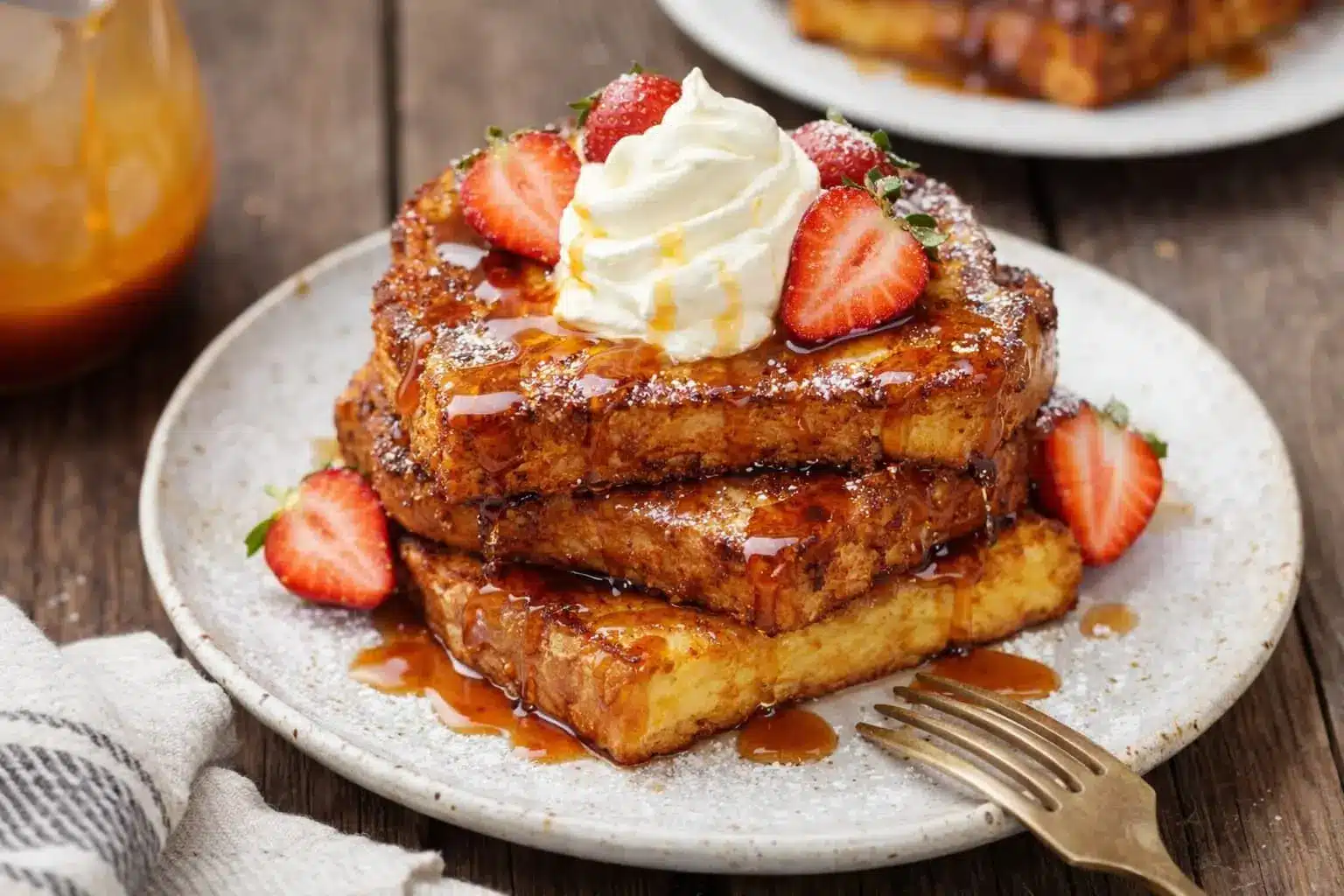
How to Make Fluffy French Toast (Light and Airy Every Time)
Fluffy French toast isn’t a matter of a longer ingredient list or a recipe someone is hiding from you. It comes down to a handful of choices most people make without thinking. The bread. How long it sits in the custard. How hot the pan runs. Those are what separate a slice that’s light in the middle from one that’s flat, wet, or oddly dense.
So what does fluffy actually mean here? Structure and air. The outside holds together. The inside stays soft and full of little pockets instead of turning into a wet sponge. You get that on purpose, not by luck.
If you’ve never made the plain version, start with the tested method in my basic French toast guide and come back here once the technique feels familiar. This article is about one thing: control over texture.
What fluffy really means
Fluffy is not the same as thick.
That confusion sends a lot of people wrong. A very thick slice with a heavy, saturated middle isn’t fluffy. It’s just big. Real fluffiness comes from trapped air and a structure gentle enough to hold it, the same principle behind pancakes and soufflés, applied to a pan and a slice of bread.
Four things have to line up:
- the custard carries enough air;
- the bread absorbs liquid evenly instead of all at once;
- the heat sets that structure slowly;
- the moisture is balanced rather than excessive.
Miss one and the lightness goes with it.
Why so much French toast turns out dense
The usual culprits are boring and fixable. Bread left in the custard too long. Slices too soft or too thin to hold anything. A pan running too hot. Too much liquid against too little structure. And, more often than you’d think, a custard that was stirred rather than whisked.
None of that is bad luck. It’s mechanics.
Eggs do more than bind
Eggs are where the structure and the lift come from, but having eggs in the bowl isn’t the point. What you do with them is.
Whole eggs bring richness and body. The whites bring air. Whisk them well enough and you fold that air straight into the custard, and it’s exactly that air that separates a flat slice from a light one. You don’t need to whip the whites separately in a second bowl. You do need to whisk properly, for longer than feels necessary, until the mixture looks slightly foamy rather than merely mixed.
A lazy stir will not get you there.
The milk-to-egg ratio
Most recipes gloss over this, and it matters more than almost anything else on the list. Too much milk thins the custard out and the structure collapses. Too little liquid and the toast turns heavy and eggy.
The proportion that holds up is roughly 2 large eggs to ½ cup of milk, which is what the recipe at the end of this article uses. Half-and-half in place of the milk makes it richer without thinning it.
What you want is something that coats the bread rather than soaking straight through it. Think custard, not liquid: rich, a little thick, clinging to the back of a spoon. A thicker mixture is what supports the lift and keeps sogginess out.
Bread choice is physics, not preference

Not every loaf can become fluffy French toast, and no technique rescues the wrong one.
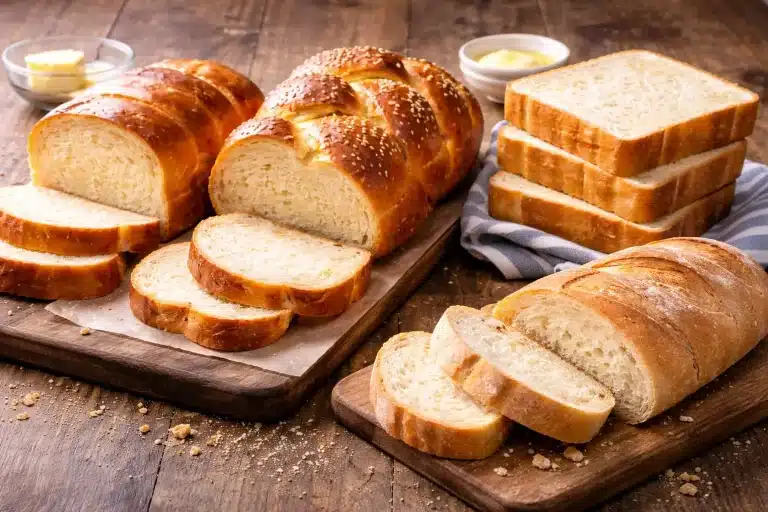
Soft sandwich bread drinks the custard too fast and collapses under it. Very dense bread resists absorption and stays heavy from edge to edge. What you want sits between the two: internal air pockets, plus enough structure to keep those pockets open once they’re wet.
Brioche and challah both do this well, though thickness matters more than the label on the bag. Cut at least ¾ inch. Anything thinner has no interior left to stay light.
Slightly stale bread is better than fresh, which surprises people. Fresh bread compresses the moment moisture hits it. Day-old bread absorbs slowly and evenly, and the air stays where you want it.
My breakdown of which loaves actually perform goes deeper if you want to compare options before you shop.
Soak less, not more
Longer soaking does not make French toast fluffier. It makes it heavier, and it’s probably the single most common mistake in this whole recipe.
Absorption needs to be controlled. The custard should coat the interior, not flood it. A quick dip of a few seconds a side is usually all it takes. Pick the slice up: if it feels heavy in your hand or drips, it’s already gone too far.
Heat controls lift
High heat is where fluffiness goes to die.
Drop a slice into a pan that’s too hot and the outside sets on contact while the inside is still liquid. Steam rushes out, the structure never has time to form, and what you get is a browned shell around a damp middle.
Medium to medium-low gives the interior time to firm up gradually and hold onto the air instead of releasing it. It’s the least glamorous instruction in this article and probably the most important one.
Butter, oil, or both
Butter tastes better. Butter also burns, and burnt butter pushes people to fiddle with the heat, which undoes everything in the section above.
Use both. The neutral oil raises the smoke point and keeps the pan stable; the butter does what butter does. Steady heat, steady structure.
The one addition that changes everything
A small amount of baking powder in the custard.
It isn’t traditional, and it isn’t necessary. But used sparingly it gives a gentle lift without tipping the flavor toward pancake. It reacts with the heat and the moisture and opens up tiny air pockets throughout the custard as the slice cooks. A quarter teaspoon is plenty for four slices. More than that and you’ll taste it.
Let it rest, and stop flipping
Two small habits, both about leaving things alone.
After dipping, let the slices sit for 30 to 60 seconds before they hit the pan. That pause lets the custard settle evenly through the bread instead of pooling at the surface, and it’s the difference between an even crumb and a wet patch in the middle. Rushed French toast is almost never fluffy.
Then, in the pan, flip once. Only once. Every extra flip presses air and moisture out of a slice that’s still setting, and you undo the work the heat is doing for you.
Finishing thick slices in the oven
For slices at the upper end of the thickness range, searing in the pan and finishing in a low oven preserves more air than trying to cook them through on the stovetop alone.
The pan gives you the crust. The oven sets the center gently, with no pressure on it. It works especially well for brunch-style French toast, and and it is the step that makes the difference on the thickest slices.
Flavor and toppings that don’t weigh it down
Heavy sweeteners and thick syrups stirred into the custard add density before the bread ever reaches the pan. Keep the custard lightly seasoned and add the sweetness afterward.
Vanilla, cinnamon, nutmeg and a little citrus zest give you aroma without weight, and none of them fight the texture the way a heavy syrup does.
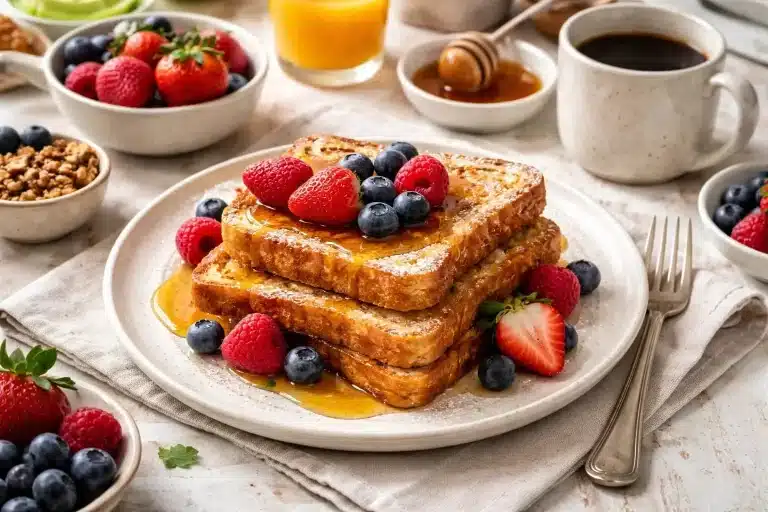
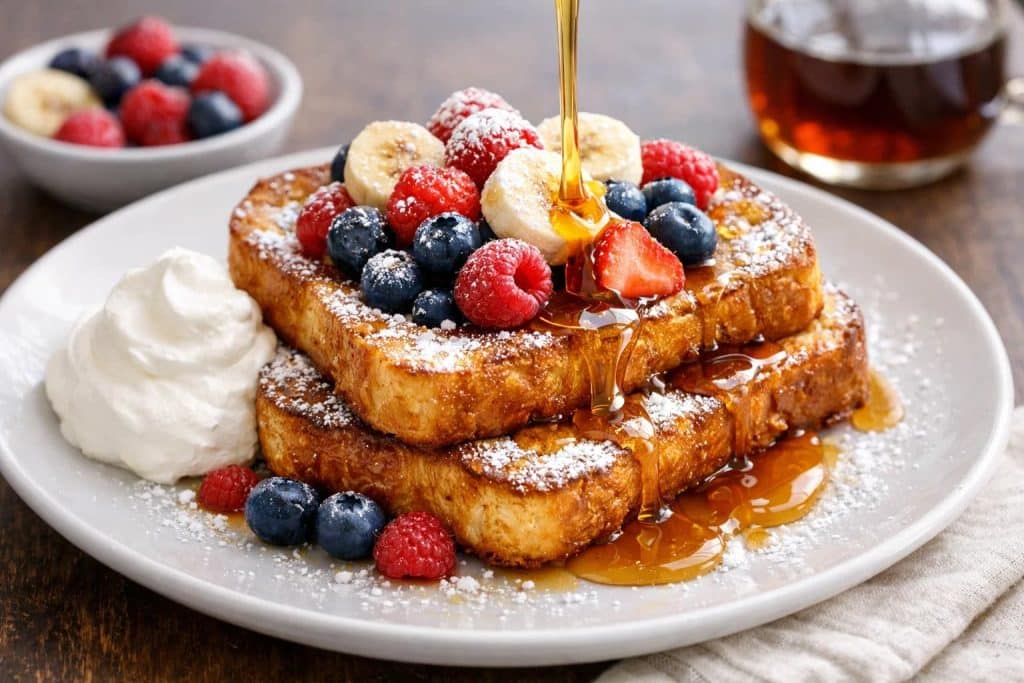
On the plate, the same rule holds. Fresh fruit, a dusting of powdered sugar, warm maple syrup poured right before serving, whipped yogurt or lightly whipped cream. Anything dense and cold flattens the slice while you’re still deciding where to start.
Common mistakes that kill fluffiness
Even people who cook well fall into these:
- pressing the bread down with a spatula while it cooks;
- cutting slices too thin;
- over-soaking;
- rushing the pan with high heat;
- stirring the custard instead of whisking it.
Making it ahead
Fluffy French toast is best straight from the pan, but it survives being made in advance if you’re careful about the reheat.
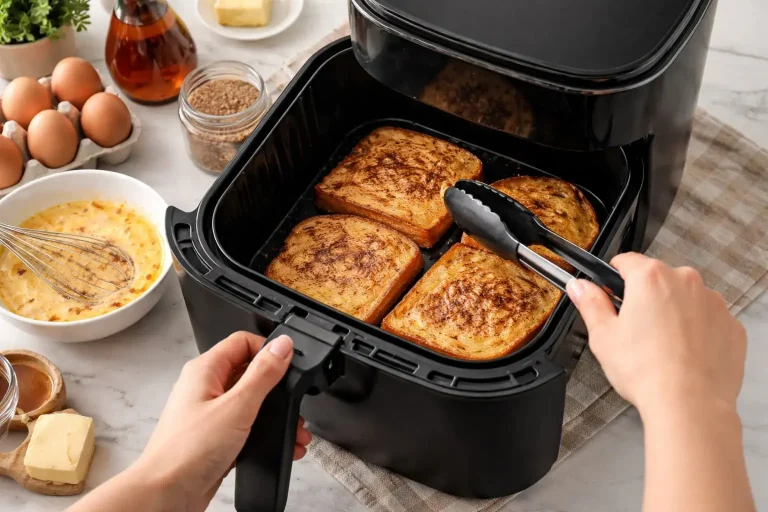
Cook it gently, cool it completely, and warm it in the oven rather than the microwave. The oven brings the structure back; the microwave steams it into submission. An air fryer works well too, and reheats without flattening.
Fluffiness is a decision
None of this happens by accident. Bread, custard, air, heat, timing: get those right and the texture stops being a surprise every Sunday and starts being something you can repeat.
That’s the whole difference between French toast that photographs well and French toast that actually eats light.
Quick recipe: fluffy French toast, step by step
Ingredients (for 4 slices)
- 4 slices of brioche or challah, about ¾ to 1 inch thick, slightly stale
- 2 large eggs
- ½ cup whole milk or half-and-half
- 1 tablespoon sugar
- ½ teaspoon vanilla extract
- ½ teaspoon ground cinnamon (optional)
- ¼ teaspoon baking powder
- Pinch of salt
- 1 tablespoon butter
- 1 tablespoon neutral oil (such as canola or sunflower)
Step 1 – Make the fluffy custard
In a bowl, whisk the eggs until slightly foamy. Add the milk, sugar, vanilla, cinnamon (if using), baking powder and salt. Whisk well until smooth and a bit airy.
Step 2 – Prepare the bread
Cut the bread into ¾ to 1-inch slices if it is not already. If the bread is very fresh, let it sit out for 10 to 15 minutes so it dries slightly.
Step 3 – Dip quickly and let it rest
Dip each slice into the custard for just a few seconds per side, until coated but not heavy or dripping. Place the dipped slices on a plate or rack and let them rest for 30–60 seconds so the custard spreads evenly inside.
Step 4 – Cook over medium heat
Heat a non-stick skillet over medium to medium-low heat. Add the butter and oil and let them melt together. Place the slices in the pan with space between them. Cook for about 2–3 minutes per side, flipping only once, until golden brown and slightly puffed.
Step 5 – Finish and serve
For very thick slices, you can transfer them to a 300°F (150°C) oven for 5 minutes to finish setting the center. Serve immediately with light toppings such as fresh fruit, powdered sugar and a small drizzle of warm maple syrup.