How to Make Brazilian Feijoada: An Authentic Recipe Guide
Feijoada is Brazil’s national dish: black beans and pork, simmered slowly until humble ingredients turn into something people plan their whole Saturday around.
Once you’ve made it at home, the ritual makes sense. The pot goes on in the morning, people arrive throughout the afternoon, and you serve it with rice, farofa, and orange slices at a table that keeps growing.
This guide covers the ingredients, method, and side dishes that make it a meal rather than a stew, so you can put a genuine version on your own table wherever you live.
The history behind the dish
Feijoada took shape in colonial Brazil, out of the meeting of African, Portuguese, and indigenous cooking. Black beans were cheap and plentiful, and what began as a way to feed people well with very little grew into a dish with many meats and a permanent place at the center of Brazilian cuisine.
The African influence shows most clearly in the bean stew itself. The Portuguese contribution shows in the meats and several ingredients not native to Brazil.
Why it’s a Saturday dish
Feijoada is not really a meal. It’s an occasion.
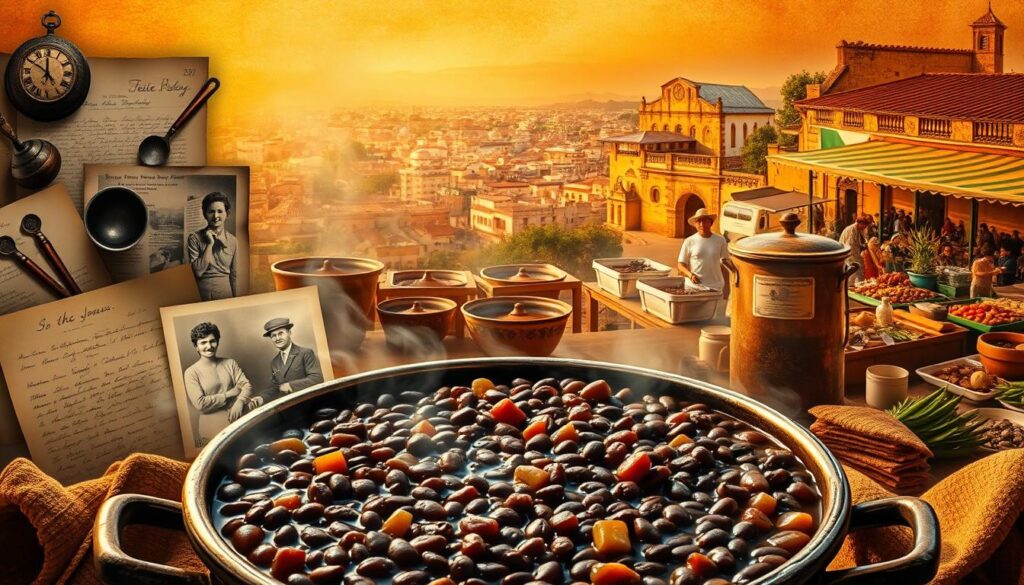
It’s traditionally served on Saturdays, for practical and cultural reasons: it takes hours, feeds many, and improves as people talk. It turns up at gatherings and celebrations for the same reason.
As the dish everyone eats across every part of the country, it carries a lot of what Brazil understands about itself.
Essential ingredients
The list is short, and quality does most of the work.
The meats
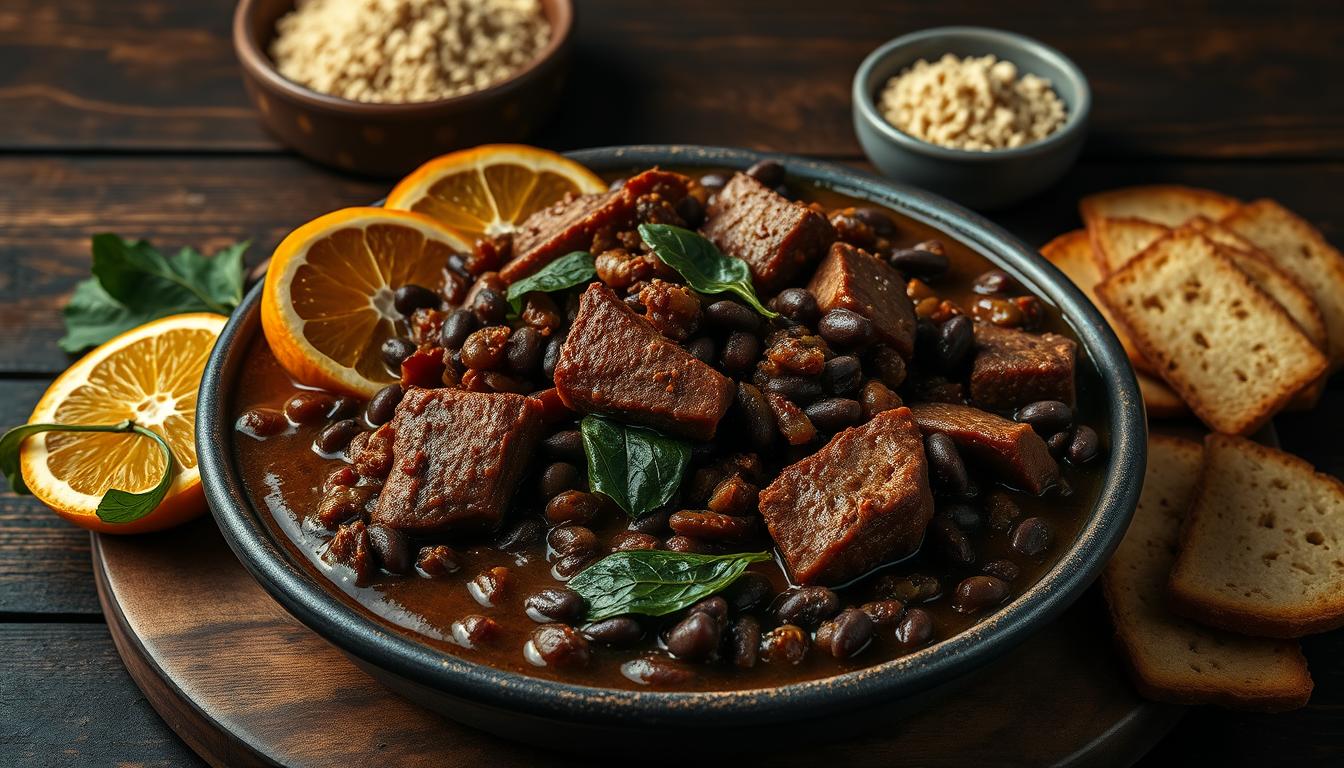
A traditional feijoada uses several, and the variety is the point, not an indulgence. Pork, beef, and sausages like linguiça or paio are the backbone, and together they build the depth a single meat can’t achieve on its own. Ribs and bacon push it further still.
What matters is the balance between them. Mixing smoked and fresh sausages creates contrast instead of one flat, salty note running through the whole pot, and choosing cuts that cook at different speeds gives the finished stew a range of textures.
Black beans and seasoning
Black beans are the heart of it, cooked with the seasonings that turn them from beans into feijoada: onions, garlic, and the spices common to Brazilian cooking. Bay leaves and cilantro add depth, and the seasoning is genuinely what separates this from any other bean stew.
Use good beans and cook them until genuinely tender. Undercooked beans can’t be rescued later, and no amount of seasoning covers for them. Once you know the base, the spices and herbs are worth experimenting with until the pot tastes like yours.
What you’ll cook it in
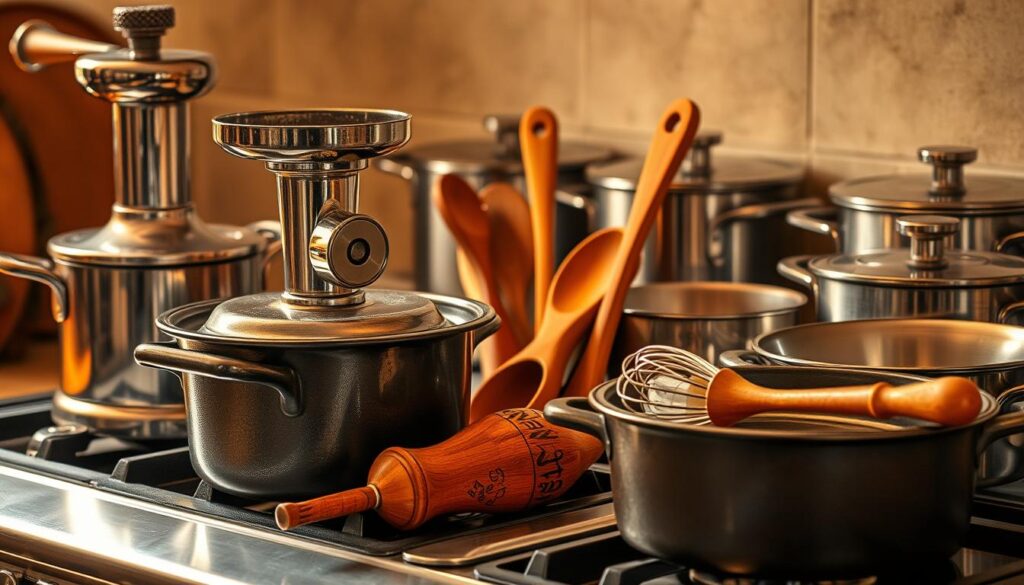
Feijoada was traditionally made in clay pots over open flame, and clay does add something. Most kitchens now use stainless steel or a pressure cooker, which are faster and considerably easier to clean.
Pressure cooker if the day is short: it gets the beans tender quickly. Slow cooker if it isn’t: long, gentle cooking deepens the flavor while you do something else. Both produce a good result, so the choice is about your afternoon rather than the recipe.
Preparing the ingredients
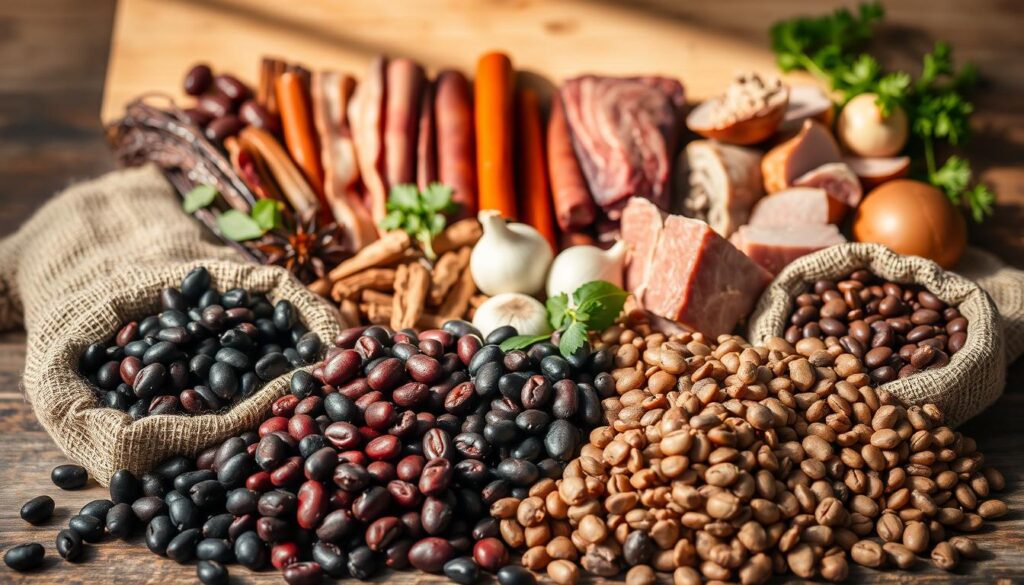
Getting this part right is most of the battle.
Soaking the beans
Cover the black beans with water in a large bowl and leave them overnight. Soaking shortens the cooking time and makes them easier to digest.
The next day, drain and rinse them properly, checking for debris or small stones as you go.
Tip: dried or canned both work. If you’re using canned, rinse them well before they go anywhere near the pot.
Cutting and seasoning the meat
Cut the sausages into thick rounds and everything else into bite-sized pieces so they cook evenly. Uneven pieces are the most common reason one mouthful is tender and the next is not. Season with salt and spices such as garlic, black pepper and cumin, and do it before anything goes in the pot rather than after.
The cooking process
Straightforward, and dependent on timing more than technique.
Start with the beans
The beans are the foundation, so they go first. A pressure cooker is the efficient choice: add the soaked beans with enough water to cover, and cook until tender.
Without one, a large pot on the stovetop or a slow cooker does the same job more slowly. Either way, the beans need to be soft and to have taken on flavor before anything else joins them.
Add the meats, in order
Order matters here.
Start with the tougher cuts, the pork ribs and the sausages, and let them cook until tender. The rest go in afterward, timed to their own texture.
| Meat Type | Cut Size | Seasoning Suggestions |
|---|---|---|
| Pork | Bite-sized pieces | Salt, garlic, black pepper |
| Sausages | Thick rounds | Black pepper, cumin |
| Beef | Bite-sized pieces | Salt, garlic, black pepper |
The meats aren’t only there for variety. They enrich the broth as they cook, and that broth is what makes the difference between a bean stew and feijoada.
Adjust at the end
Once the beans and meats have cooked together, taste the broth and correct the salt and pepper.
This is also the moment for a little vinegar if the pot needs lifting. Feijoada is rich by design, and a small amount of acid at the end keeps that richness from turning heavy.
The side dishes
Feijoada is served with a specific set of accompaniments, and they aren’t decoration. Each one is balancing something.
White rice
A staple of Brazilian meals and essential here. Use long-grain rice, sauté it briefly in oil, add water, and cook until it’s absorbed. You want it fluffy and separate, not creamy, because its job is to carry the broth rather than compete with it. Sticky rice turns the plate into one texture, which is exactly what the other sides exist to prevent.
Farofa
Toasted manioc flour, and non-negotiable at a feijoada table. It brings crunch against everything else being soft, which is the contrast the whole plate is built around.
Heat butter or oil, add the manioc flour, and stir until it toasts. Salt, onions or bacon bits can go in with it.
Collard greens and orange slices
Couve, chopped fine and sautéed with garlic and sometimes bacon, cuts through the richness. Chop it as thinly as you can manage, sauté it quickly so it keeps its color, season with salt, and stop there.
Orange slices go on the side and are there to reset your palate between mouthfuls. They look like garnish, they get skipped by people who don’t know the dish, and they are doing more work than anything else on the table.
Rice, farofa, couve and orange together are what make the plate Brazilian rather than simply a stew.
Serving it like a local
Presentation matters more than you’d expect, mostly because feijoada is communal by nature.
It’s served in large decorative bowls or individual ones, garnished with fresh cilantro or scallions, surrounded by the side dishes rather than plated with them. Nobody hands you a finished plate at a feijoada. People build their own, and the proportions of rice to beans to farofa become a small matter of personal conviction.
| Component | Description |
|---|---|
| Feijoada | The main dish, made with black beans and various meats |
| White Rice | A staple side dish that complements the flavors of feijoada |
| Farofa | Toasted manioc flour that adds texture to the meal |
| Sliced Oranges | A refreshing contrast to the rich flavors of feijoada |
Drink pairings
No Brazilian meal is complete without something cold alongside it, and the classic pairing is the caipirinha. Never mixed one? Here’s how to make a caipirinha at home with nothing but lime, sugar and cachaça.
Whatever you pour, the job is the same: cut through the richness rather than compete with it.
If you’re planning the whole spread, the feijoada, the rice, the farofa, the couve and the oranges, it helps to have everything in front of you at once instead of scrolling back and forth. That’s why I put the Brazilian Feijoada Recipe Book together: the full recipe, all the sides, what to start when, and a bilingual ingredient list so you can actually find what you need at an American market.
Storing and reheating
Feijoada is usually made in quantity, so this matters.
Storing
Let it cool before it goes into airtight containers. Sealing it warm invites bacteria and dulls the flavor.
Refrigerated, it keeps 3 to 5 days. Frozen, it keeps up to 3 months and freezes genuinely well. Use freezer-safe containers and write the date on them.
Reheating
Gently, always. On the stovetop over low heat, stirring occasionally, until it’s hot through. Rushing it on high heat breaks the beans down and turns the broth cloudy.
The microwave works if you stir every 30 seconds so it heats evenly rather than scorching at the edges. If it has thickened in the fridge, which it will, a little water or broth loosens it back to where it should be. Done carefully, feijoada is one of the few dishes that genuinely improves on the second day.
Adapting it
Traditional feijoada is meat-heavy. It doesn’t have to stay that way.
A lighter version
Use less meat, choose leaner cuts and less fatty sausages, and increase the proportion of beans so the pot still has body. You lose some of the depth and keep the character, which for a weekday version is usually the right trade.
Vegetarian and vegan
Plant-based meats work, and portobello mushrooms work particularly well because they hold up to long cooking. Tofu, tempeh and seitan are all options, marinated and cooked so they carry some of the smokiness the meats would have brought.
| Component | Traditional Feijoada | Lighter Feijoada |
|---|---|---|
| Meat | Variety of meats, including pork and sausage | Leaner meats or less quantity of meat |
| Beans | Black beans | Increased proportion of black beans |
| Flavor Profile | Rich, meaty flavor | Balanced, slightly less intense |
For a fully vegan version, use vegetable broth in place of anything animal-derived, and check the sausages or meat substitutes carefully.
Making it yours
Feijoada is more than food. It’s the reason a dozen people end up in the same kitchen on a Saturday, and the first mouthful usually explains the fuss better than any description does.
Experiment with it. Add the meats and spices you like. Brazilian cooking has never been precious about rules, and the whole point is warmth and having people over.
Cook it, invite everyone, and let the afternoon go long. Nobody in Brazil makes feijoada for one person, and the dish is built for that: it scales up easily, it holds well on low heat while people arrive, and it tastes better the longer the table stays full. That’s the tradition, more than any particular ingredient is.
Want it all in one place?
You now have everything you need to make feijoada at home. If you’d rather have the whole thing organized, with the full recipe, every side dish, the timings, and a bilingual shopping list you can take to the market, the Brazilian Feijoada Recipe Book puts it together for you. It also includes bonus recipes for caipirinha and caipivodka, the two drinks Brazilians pour alongside it.
Get the Brazilian Feijoada Recipe Book →
FAQ
What is feijoada, and is it a Brazilian dish?
Feijoada is a hearty black bean and pork stew widely considered Brazil’s national dish. Its roots trace back to Brazil’s colonial period, when African, Portuguese, and indigenous cooking traditions blended around the pot of black beans. It’s traditionally served on Saturdays, as a social, family-style meal.
What are the essential ingredients for an authentic Brazilian feijoada recipe?
Black beans (feijão preto) are the base. The meats typically include pork ribs, bacon, smoked sausage (linguiça), and paio or chorizo, plus beef cuts. Onions, garlic, bay leaves, salt, and black pepper build the seasoning. The sides that complete the plate are white rice, farofa, collard greens, and orange slices.
Can I make feijoada in a pressure cooker or slow cooker?
Yes, both work well. A pressure cooker softens the beans in roughly 30–45 minutes and is ideal for busy days. A slow cooker simmers gently for 6–8 hours, deepening the flavor. Either way, cook the beans until tender before adding the meats.
How do I prepare the black beans for feijoada?
Soak dried black beans in plenty of water overnight (at least 8 hours), then drain and rinse to remove debris. If you’re short on time, a quick-soak in boiling water for 1 hour works. Canned black beans are an acceptable shortcut, just rinse well before using.